Students,
Please use the username and password I will give you to log on to this site:
www.tellthemfromme.com
When you are finished, please visit this site,
http://www.mbam.qc.ca/en
and poke around at what we may see tomorrow.
Thank you,
Ms Napier
Monday, April 29, 2013


Thursday, April 25, 2013
Technology Use, Special Visitors and Grade Six Projects
Hello Families,
Has your sixth-grader been more tired than usual lately?
In the last two weeks grade six has had a number of interesting projects and activities, ones I hope they have already spoken to you about. They have been participating with enthusiasm and working very hard.
Last week we had the opportunity, through the Discovery Education Network, to participate in a live webcast from Proudfoot Elementary school in Saskatchewan. This Cree school shared why it is important to them to include aspects of their Native identity as part of their daily activities in school, including the role of tribal elders in teaching Cree language and culture. We had the chance to see two Pow-wow dances and hear a drum circle, and the students and teachers spoke about how their school is similar and different to schools off reserves. This webcast was very timely, as our unit on Native Culture continues into next month.
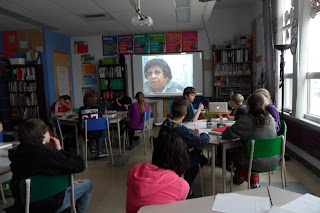
As part of our Language Arts program, the students have been working on book reviews. Students had a chance to hear from experienced book reviewer (and my father) Jim Napier, who in his retirement has begun to review mystery and crime fiction for two newspapers and several on-line websites. Students were amazed to learn that he receives between 400 and 600 books a year from publishers, though he reviews only a fraction of them. He joined the class via Skype for a one hour lecture and discussion of what makes a review effective. You can see some of his work on his website, Deadly Diversions.

In that same week, we had a visit from naturalist Kat Usher of the Earthvalues Institute in Montreal. Kat has been visiting our school once a year for the last twelve years, sharing her knowledge of science and connecting what students know about the natural world to bigger issues of conservation and sustainability. Students love Kat for her sense of humour and her warm personality, her carefully prepared presentations and the thoughtful way with which she answers questions. Many thanks to the St Francis Valley Naturalist Club, who underwrite this visit. It was, as always, a very interesting and informative presentation!

Student have also been preparing biographical presentations about famous artists as part of the lead up to our visit to the Musee des Beaux Arts next week. With everything going on lately, these won't be finished before Tuesday, but the students have been working hard and have shown great enthusiasm for the subject.

This week's big project deserves it's own post. Hope to write you soon about our Writer's Workshop two-day event and the wonderful ebooks that were produced.
Warm regards,
Kathy Napier
Has your sixth-grader been more tired than usual lately?
In the last two weeks grade six has had a number of interesting projects and activities, ones I hope they have already spoken to you about. They have been participating with enthusiasm and working very hard.
Last week we had the opportunity, through the Discovery Education Network, to participate in a live webcast from Proudfoot Elementary school in Saskatchewan. This Cree school shared why it is important to them to include aspects of their Native identity as part of their daily activities in school, including the role of tribal elders in teaching Cree language and culture. We had the chance to see two Pow-wow dances and hear a drum circle, and the students and teachers spoke about how their school is similar and different to schools off reserves. This webcast was very timely, as our unit on Native Culture continues into next month.

As part of our Language Arts program, the students have been working on book reviews. Students had a chance to hear from experienced book reviewer (and my father) Jim Napier, who in his retirement has begun to review mystery and crime fiction for two newspapers and several on-line websites. Students were amazed to learn that he receives between 400 and 600 books a year from publishers, though he reviews only a fraction of them. He joined the class via Skype for a one hour lecture and discussion of what makes a review effective. You can see some of his work on his website, Deadly Diversions.

In that same week, we had a visit from naturalist Kat Usher of the Earthvalues Institute in Montreal. Kat has been visiting our school once a year for the last twelve years, sharing her knowledge of science and connecting what students know about the natural world to bigger issues of conservation and sustainability. Students love Kat for her sense of humour and her warm personality, her carefully prepared presentations and the thoughtful way with which she answers questions. Many thanks to the St Francis Valley Naturalist Club, who underwrite this visit. It was, as always, a very interesting and informative presentation!

Student have also been preparing biographical presentations about famous artists as part of the lead up to our visit to the Musee des Beaux Arts next week. With everything going on lately, these won't be finished before Tuesday, but the students have been working hard and have shown great enthusiasm for the subject.

This week's big project deserves it's own post. Hope to write you soon about our Writer's Workshop two-day event and the wonderful ebooks that were produced.
Warm regards,
Kathy Napier
Monday, April 15, 2013
Math Practice and the Ministry Exams
 |
| This photo has nothing to do with the following post. But just the same, Yay Team! |
Hello Families,
Over the last week a couple of families have gotten in touch about having some extra work to prepare for the ministry exams. While I have sent some photocopies when asked, there is a great deal of free material on the internet.
That said, finding information on the internet is "like taking a drink from a fire hydrant" (Mitchell Kapor, via Lucacept).
So apart from the sites listed on the sidebar of this blog, here are some sites I can recommend:
Math Frog, where you will find self-correcting games students can use to practice skills
Math Games, a site I am still exploring but that has many levels of practice available for students.
Bedtime Math, which has a "problem of the day" format with leveled questions to help the whole family get involved, and has tips for helping kids find math fun
Figure This! Math Challenges work different problem-solving skills, with and without calculation
A+ Click gives you math practice by grade level and by are of math, and lets you browse math question by thumbnail.
IXL provides math sheets with Canadian content links, so that you can see what kids need to know in our province
Math is Fun offers one of the best illustrated Math Dictionaries on the web
Most of these sites I found on the metasite Great Websites for Kids, sponsored by the American Library Association. This site provides sites for students to use that are from reputable sources and offer sounds academic value, sorted by subject and rating.
For many of the students, current math errors are not a result of misunderstanding of concepts, but rather calculation inaccuracies and shortcuts in procedures that lead to errors. If this is the case for your child, having them practice their skills is still the best way you can help them. Ipod apps such as PopMath are painless ways to have them squeeze in extra practice on the go.
One of the best ways to help you child is still to check their homework. Insist they correct any mistakes you find, that they present solutions that are complete and diagrams that are fully labelled, and that they use the formula they are taught.
Thank you, once again, for all that you do to help your child, and please let me know if there are any questions I can answer.
Warm regards,
Kathy Napier
Saturday, January 26, 2013
Light Reading for Parents
Hello Families,
Often when I am reading on-line I will come across an article that I think may be interesting to the parents of my students. I bookmark it and save it until it comes up in conversation but rarely do I get a chance to share it at large, so today I am posting links to a few articles I think might interest you. Anytime words below are coloured, they will lead to an article.
The first was shared with the students already. You should have seen the shock on the kids' faces! It is hard to imagine, but research shows that a student who reads 20 minutes every day will read about 1 800 000 words by the end of sixth grade, while a student who reads ten minutes once a week (or 1 minute a day) will read only 8 000 words in the same time-span. This article on Edudemic has an interesting infographic on the effects of skipping reading homework.
The ideas in this article from TIME magazine were also shared with the students, to help dispel the idea that only 'smart' kids can do math. Motivation, not IQ, determines how much someone learns, showing that a positive attitude and perseverance are the key to achievement.
Sleep is also a big concern when I speak with parents, and it should be. Sleepiness can cause learning, behaviour, and attention problems, all of which can negatively affect students' academic achievement and their ability to form healthy relationships. It is recommended that children in grade six get ten to eleven hours of sleep a night, particulalry as their rapid growth at this age can leave them feeling tired more easily. This article lists reasons why today's children sleep less than previous generations, and tells us what we can do about it.
The last two sites I have to share I found after the tragedy at Sandy Hook Elementary, when I wanted to prepare myself to face students' questions and concerns about safety and violence against children. One is from the University of Minnesota, "Talking to Your Children About Violence Against Kids," and the second is more general, and deals with talking to kids about death. Neither is a conversation we want to have, but when we as adults don't give kids a chance to discuss hard topics, we risk having them get all their information from peers and from the media.
Please feel free to share additional helpful sites and articles in the comments below.
Warm regards,
Kathy Napier
Often when I am reading on-line I will come across an article that I think may be interesting to the parents of my students. I bookmark it and save it until it comes up in conversation but rarely do I get a chance to share it at large, so today I am posting links to a few articles I think might interest you. Anytime words below are coloured, they will lead to an article.
The first was shared with the students already. You should have seen the shock on the kids' faces! It is hard to imagine, but research shows that a student who reads 20 minutes every day will read about 1 800 000 words by the end of sixth grade, while a student who reads ten minutes once a week (or 1 minute a day) will read only 8 000 words in the same time-span. This article on Edudemic has an interesting infographic on the effects of skipping reading homework.
The ideas in this article from TIME magazine were also shared with the students, to help dispel the idea that only 'smart' kids can do math. Motivation, not IQ, determines how much someone learns, showing that a positive attitude and perseverance are the key to achievement.
Sleep is also a big concern when I speak with parents, and it should be. Sleepiness can cause learning, behaviour, and attention problems, all of which can negatively affect students' academic achievement and their ability to form healthy relationships. It is recommended that children in grade six get ten to eleven hours of sleep a night, particulalry as their rapid growth at this age can leave them feeling tired more easily. This article lists reasons why today's children sleep less than previous generations, and tells us what we can do about it.
The last two sites I have to share I found after the tragedy at Sandy Hook Elementary, when I wanted to prepare myself to face students' questions and concerns about safety and violence against children. One is from the University of Minnesota, "Talking to Your Children About Violence Against Kids," and the second is more general, and deals with talking to kids about death. Neither is a conversation we want to have, but when we as adults don't give kids a chance to discuss hard topics, we risk having them get all their information from peers and from the media.
Please feel free to share additional helpful sites and articles in the comments below.
Warm regards,
Kathy Napier
Thursday, December 6, 2012
Blogging Code of Conduct - Final Draft
After much careful consideration, here are the Internet blogging
rules the students have developed and pledge to respect. I think they
have done an exceptional job. Good work, Grade 6!
Code of Conduct
1. I am responsible for my posts. My posts and comments will be interesting, respectful, appropriate, and truthful. I will do my best to make my work grammatical, to limit abbreviations, and to make sure my work doesn’t repeat.
2. I will disagree politely and will report inappropriate content.
3. I will keep my password, personal information, contact information, and location to myself. I will only use my own password.
4. I will be respectful of other people’s personal lives and their privacy.
5. I will ask permission before taking or posting photos of others. I will only use unaltered photos (no ‘photoshoped’ images).
6. I will use my own words, work, and photos, or give credit when necessary.
7. I will only write things to or about people that I would be willing to say to their face.
8.I will keep gossip and personal comments to myself.
9. I will listen to my teacher and respect the school rules at all times.
10. I will stay on task.
Parents, please keep in mind that you are welcome to join our kidblog community. Leave a comment here, or send a note to school, and I can send you a username and password.
Best,
Kathy Napier
Code of Conduct
1. I am responsible for my posts. My posts and comments will be interesting, respectful, appropriate, and truthful. I will do my best to make my work grammatical, to limit abbreviations, and to make sure my work doesn’t repeat.
2. I will disagree politely and will report inappropriate content.
3. I will keep my password, personal information, contact information, and location to myself. I will only use my own password.
4. I will be respectful of other people’s personal lives and their privacy.
5. I will ask permission before taking or posting photos of others. I will only use unaltered photos (no ‘photoshoped’ images).
6. I will use my own words, work, and photos, or give credit when necessary.
7. I will only write things to or about people that I would be willing to say to their face.
8.I will keep gossip and personal comments to myself.
9. I will listen to my teacher and respect the school rules at all times.
10. I will stay on task.
Parents, please keep in mind that you are welcome to join our kidblog community. Leave a comment here, or send a note to school, and I can send you a username and password.
Best,
Kathy Napier
Tuesday, November 27, 2012
Blogging in the Literacy Classroom
Dear Families,
This
year, after several year of reflection on my part, the grade six class will be
using student blogs. Blogs are journal-like webpages in which students create and
post text and media content. While I had begun learning about student blogging
five years ago, my concerns about safety and the management of the blogs had
kept me from using this in the classroom. Now, using the kidblogs platform,
students will be able to create a blog with a private audience that I
administer, and which will be closed at the end of the school year.
Blogging
allows us to enhance the literacy program while addressing skills and needs of
the 21st century classroom. Blogs can be used:
- as platforms for expanding the writing program and providing authentic audiences for their writing
- to motivate writers, as a way of promoting discussion, and as a way of learning from their classmates
- to improve communication by helping them consider their audience and learn to express themselves formally and informally
- to harness the impact of technology to improve the quality of student writing, both at the technical and content level
- to learn how to interact positively, prosocially, in a digital forum
- to solicit feedback and promote interaction in a safe, closed community
- to allow parents and family members, near and far, to comment and interact with their child's work
- to learn to use technology safely, and to learn to protect their privacy
- to help students establish a positive digital footprint
With my
guidance, the students will also establish a code of conduct for participating
in the blogging project, and will examine ways in which on-line interaction
(social media and other) has consequences in the 'real' world. We will discuss
the changing nature of technology, and discussions of privacy, sharing, and
cyberbullying will be part of the project.
I am very
excited about this new project, and know that the students will be motivated by
this new platform. We invite you to become part of our learning community, and
hope that you will also be an active participant in this process.
As
always, if you have questions or concerns, I am will be happy to discuss this
further with you or provide you with additional information. Please contact me for a username and password to be able to view and comment on the blogs.
Warm regards,
Kathy Napier
Monday, October 15, 2012
October Photos

Of the may official communications that come home, none really allows me to capture the rhythm and flavour of our days.
I wanted to share with you some of the images I took of the students last week. We had a wonderful time at the Soccer tournament, winning as many games as we lost, and shivering through the snow just seemed to make it more memorable. It is always so much fun to see the students participate and encourage each other, and despite the fact that some children play soccer all summer and some rarely play, everyone had such a marvelous attitude and such team spirit.


Things are going absolutely swimmingly in grade six. The students work well together, and since they genuinely want to improve, everyone works hard on assignments and activities. The other day, I taught a lesson, set the activity, then sat back and watched. This is what I saw:


Many intangible things don't make it onto official communications, but they may still be important to know. Please let you children know how proud I am of them, and how much I am enjoying spending the days with them. It's shaping up to be a wonderful year.
Thanks for stopping by,
Kathy Napier
Subscribe to:
Posts (Atom)